

At the core of everyone’s worldview lies a small set of assumptions. Identifying these assumptions often proves difficult. I think that if we could do a better job of it, perhaps we could do a better job of understanding each other. Some of these assumptions are moral, like the chasm between the moral realists and the moral relativists. Some of them are assumptions of abundance versus scarcity, or of the basic character of human nature. Some of these assumptions are invisible –– so invisible, in fact, that most people could not tell you which side of the line they lie on or why. However, it is just such assumptions as these that form some of the major divides in individual life philosophies.
This post is about two of those assumptions, or rather categories of assumption, with problems to help the reader understand where they fall. The first category I will discuss is sampling, and the second is loosely causality dependence versus logical dependence.
Sampling Assumptions: The Sleeping Beauty Problem
The Sleeping Beauty problem is a thought experiment, first posed to me in a slightly modified version1 of the canonical form:
Sleeping Beauty volunteers to undergo the following experiment and is told all of the following details: On Sunday she will be put to sleep. Once or twice, during the experiment, Sleeping Beauty will be awakened, interviewed, and put back to sleep with an amnesia-inducing drug that makes her forget that awakening. A fair coin will be tossed to determine which experimental procedure to undertake:
If the coin comes up heads, Sleeping Beauty will be awakened and interviewed on Tuesday only.
If the coin comes up tails, she will be awakened and interviewed on Tuesday and Thursday.
In either case, she will be awakened at the end of the week and the experiment ends.
Any time Sleeping Beauty is awakened and interviewed she will not be able to tell which day it is or whether she has been awakened before. During the interview Sleeping Beauty is asked: “What is your credence now for the proposition that the coin landed heads?”
It is worth taking some time to think about your answer here, without letting the discussion that follows color your intuition, to uncover what assumption underlies the way you think about decision theory problems like this.
There are two common answers, ½ and ⅓, both with rational frameworks supporting them that simply rely on different assumptions. I will henceforth refer to these as the halfer and thirder positions.
Many take the halfer position. They say, well, a coin toss is a coin toss, your being awoken doesn’t add any information, and the probability of any given coin toss is ½. Immediately after the coin is tossed, the probability is of course ½, and you know you will be awoken regardless, so how could that possibly affect your personal credence?
I take the thirder position, because I believe I am more likely to be in one of the two tails scenarios given that I am woken up. The most convincing arguments I can give for this position are two modified versions of the problem.
The first version is a betting version. Let’s say that this experiment is run 100 times, and Sleeping Beauty is asked to bet $10 every time she is interviewed on the outcome of the coin. You can run a computer simulation of this. The bottom line is, it is significantly more profitable to bet tails, because of course over time there are more instances of being awoken in the tails scenario, with a ratio of ~2:1. This is very important. I find it difficult to think of any probability problem for which a large N repeat betting scenario does not net out to reflect the actual probability of an event.
I think halfers’ arguments are subject to Dutch books, i.e. in the betting version, they will lose money consistently. This is controversial, with some people saying they can avoid this by adopting evidential decision theory (EDT) and others saying that doesn’t save them. I will talk more about evidential decision theory in the second problem.
The second version is just a more asymmetrical version. What if instead of being woken up on Tuesday and Thursday, Sleeping Beauty is woken up 1,000 times in the tails scenario? 1,000,000 times? You are awoken. Does this asymmetry change your credence? I find that sometimes adding more asymmetry to problems helps elucidate the real decision being made.
There is also a position that the question itself is ambiguous, which divides the question into two: “what is your credence that the coin landed heads in the act of tossing,” and, “what is your credence that the coin landed heads in the toss to set up this awakening,” for which the position asserts the correct answers are ½ and ⅓, respectively. I respect this position, but I do not agree with the premise. I believe the question is clearly the latter since one has obviously already been awoken if they are being interviewed.
The real question being asked by the problem is: “does knowing you have been awoken and are in some particular scenario update your priors?” Thirders think “yes,” and are basing this on an underlying assumption called the Self-Indication Assumption (SIA) and halfers think “no,” basing their decision on an underlying assumption called the Self-Sampling Assumption.
The Self-Sampling Assumption (SSA)
All other things equal, an observer should reason as if they are randomly selected from the set of all actually existent observers (past, present and future) in their reference class.
For the Sleeping Beauty problem, since you will be awoken no matter what and you have no information about which set of observers actually exists, this assumption means that your being awake gives no additional information and ∴ P(Heads)=½.
The Self-Indication Assumption (SIA)
All other things equal, an observer should reason as if they are randomly selected from the set of all possible observers.
For the Sleeping Beauty problem, there are three possible observer-moments, 2 of which exist in the tails scenario and one of which exists in the heads scenario, ∴ P(Tails | I am awake) ∝ 2, P(Heads | I am awake) ∝ 1, and P(Heads)=⅓.
Practical Implications
These assumptions sneak their way into people’s worldview. They bias people towards one side or the other of many different important questions. Here are some of the areas potentially affected by these assumptions:
Cosmology, Fermi’s Paradox, and Multiversal Theory
SSA-leaning: Favors skepticism here, often leaning against because we have more firm evidence for just our world.
SIA-leaning: Favors multiversal theory and larger universes, as well as extra-terrestrial life, since they imply more observers. This is not necessarily proportional to some kind of infinity-to-one likeliness ratio as might be implied with a literal interpretation, since it still needs to be given that such things are physically possible.
Doomsday Argument
For this one, it is worth outlining a proposition: You learn your birth rank is some rank r among all N humans who will ever live. We notice that for large N, r is very small. The Doomsday Argument is essentially that being unusually early is evidence that N is not very large.
SSA-leaning: Under SSA, P(r|N)=1/N. Basically: If N were huge, my exact rank would be very unlikely. Doomsday is likely.
SIA-leaning: Adds a prior update, i.e. conditional on my existence, worlds with more observers are more likely. So, instead, P(N|I exist)∝P(N)⋅N. Basically: If N were huge, it would be much more likely that I exist at all. Doomsday is less likely.
Simulation Theory
SSA-leaning: Simulation theory’s likelihood gets no update based on our existence.
SIA-leaning: Since simulation theory implies many more observers, we are significantly more likely to be in a simulation than an instance of reality if realistic simulations are physically possible.
Speculative Ethics Distinctions
This one is a little more difficult to reason out, but has held true at least among SIA and SSA people I know. Consider: World A, with 10 billion extraordinarily happy people, and World B, with 10 trillion moderately happy people.
SSA-leaning: Likely small preference for World A. Number of people does not matter, because lives having not existed is not necessarily bad, as what matters is the current version of reality. It is not like you killed people, they simply don’t exist.
SIA-leaning: Likely preference towards World B. The general idea is that one is more likely to exist in worlds with more observers, existing in a moderately happy state is clearly better than non-existence, and we can apply Rawls’ Veil of Ignorance.
Causality Assumptions: Newcomb’s Problem
The original version involves an alien predictor who has come to earth named Omega, but it doesn’t really matter who the predictor is. The canonical version is as follows:
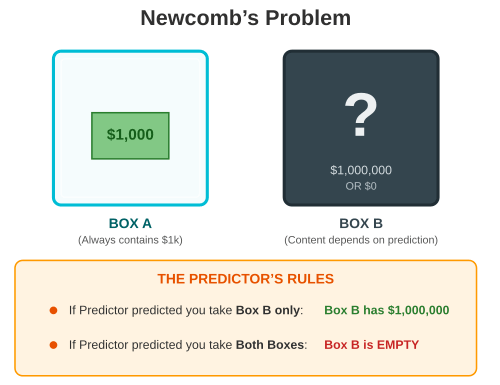
Two boxes are designated A and B. The player is given a choice between taking only box B or taking both boxes A and B. There is a perfect or near-perfect predictor who will decide beforehand what Box B will contain.
The player has the following information:
Box A is transparent, or open, and always contains a visible $1,000.
Box B is opaque, or closed, and its content has already been set by the predictor:
If the predictor has predicted that the player will take both boxes A and B, then box B contains nothing.
If the predictor has predicted that the player will take only box B, then box B contains $1,000,000.
The player does not know what the predictor predicted or what box B contains while making the choice.
It is once again worth taking time to think about your answer here, though your position is probably more immediately clear to you than in the Sleeping Beauty problem. Most people think the answer is obvious, only they disagree on what this obvious answer is. There are 2-boxers, i.e. those who would take both boxes, and there are 1-boxers, i.e. those who would take just box B. I am a 1-boxer.
Newcomb’s problem is the progenitor for a system of theories about decisions. The 2-boxers and the 1-boxers are roughly disambiguated into those operating under Causal Decision Theory (CDT), and those operating under Evidential Decision Theory (EDT).
Interestingly, SIA people are more likely to be 1-boxers, and SSA people are more likely to be 2-boxers. Generally, the SIA position correlates with EDT and the SSA position correlates with CDT, but SSA aligned people can also rationally align with EDT and vice versa. I think this correlation likely belies some other underlying assumption people are making, like generally believing one’s existence or actions contain effective information, but I suspect it’s deeper than that and have yet to identify what it is.
Causal Decision Theory (CDT)
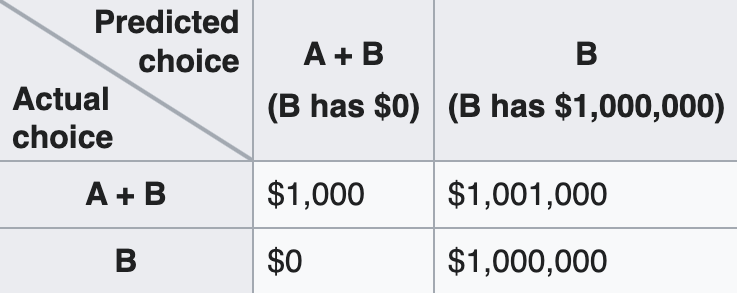
The argument 2-boxing is that the decision has already been made, i.e. box B is either already full or already empty, and therefore the decision with the highest EV (expected value) is to take both boxes.
The formal representation is this equation:
U(A): the utility of A
j∑: sum over all possible outcomes j
A: an action available to the agent
Oj: the j-th possible outcome
P(A □ → Oj): probability that outcome Oj would occur in the counterfactual world where A is performed
D(Oj): desirability (utility) of outcome Oj
Essentially, the utility of an action A is the sum, over all possible outcomes, of how desirable each outcome is multiplied by how likely that outcome would be if A were to causally produce it.
In the problem’s context, P(A □ → Oj) expresses the probability of receiving an amount of money Oj if I were to force a one-box or two-box decision A, holding fixed what the predictor has already put in the boxes, since my present action cannot causally affect that earlier decision.
To maximize “U” with this underlying assumption, picking both boxes has the highest EV.
Evidential Decision Theory (EDT)
The argument for 1-boxing is that, generally, people who only take box B are the best off.
The easiest way to understand the 1-boxer argument is to consider a limit case for the problem. Imagine that the predictor is not just very accurate, but completely omniscient and infallible. You are left with a paradigm that looks more like this:
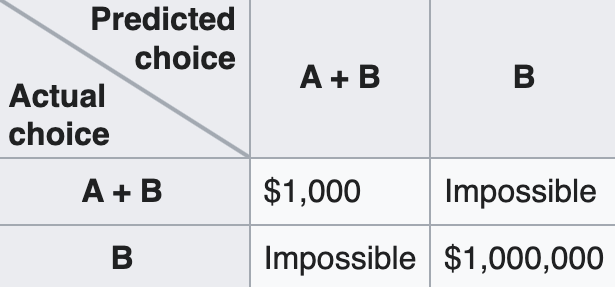
The argument is based in EDT, meaning that it is based on maximizing the expected utility of actions computed using conditional probabilities.
The formal representation is this equation:
Where:
V(A): the value of A
j∑: sum over all possible outcomes j
A: an action available to the agent
Oj: the j-th possible outcome
P(Oj|A): conditional probability that outcome Oj occurs given that action A is taken
D(Oj): desirability (utility) of outcome Oj
Essentially, the value of an action A is the sum, over all possible outcomes, of how desirable each outcome is multiplied by how likely that outcome would be conditional on you choosing A.
To maximize “V” with this assumption, picking one box has the highest EV. The EDT assumptions do not necessitate reverse causality –– in a sense, one is “choosing which world they want to live in” assuming some logical dependence between your action and features of the world(s) that already exist.
Practical Implications
These assumptions likewise sneak their way into people’s worldview. They also bias people towards one side or the other of many different important questions, several which may be even more unexpected and meaningful than those affected by sampling assumptions, because causality-linked assumptions inform the very basics about how we interact with time. CDT-leaning people are more likely to believe that causality is chief, and so the only actions that matter are the ones that change outcomes. EDT-leaning people are more likely to believe what you do is evidence of the kind of world you’re in or agent you are, so those actions matter even if they are not causal. Here are some of the areas affected by these assumptions:
Consequentialism and Moral Implications
CDT-leaning: More likely to be consequentialist and utilitarian. They are more likely to be okay with drunk driving if no one got hurt. Also more likely to side with Thanos. (A remade perfect world would be desirable if you could make it so the current world no longer exists.)
EDT-leaning: More likely to believe intent matters. For example, a bad-intent action is evidence that you are the kind of agent who causes harm. They are less likely to be okay with drunk driving if no one got hurt, and less likely to side with Thanos.
Fairness in One-Shot Games
CDT-leaning: More likely to play rationally to maximize payoff and disregard fairness in game theoretic scenarios where there is only one round.
EDT-leaning: More likely to act with fairness, even though there are no discernible consequences in a one-round game.
Funerals and Respecting the Dead
CDT-leaning: Since nothing one can do affects what has already happened, if we generally assume the dead cannot observe the living, it is not particularly important to honor the wishes of the dead, nor is it particularly important that any given wishes of “mine” are honored after my death.
EDT-leaning: More likely to believe actions can be meaningful even when they don’t causally change outcomes.
Aesthetics
CDT-leaning: More likely to believe beauty is in the eye of the beholder.
EDT-leaning: More likely to believe in the intrinsic value of beauty.
Final Thoughts
Puzzles and thought experiments like the Sleeping Beauty problem and Newcomb’s problem are incredibly useful for helping people define and understand their own philosophical alignments. They are also useful for interrogating those alignments.
Revealing underlying assumptions is an important endeavor. There are likely hundreds of assumptions making up the foundation of what any given person believes and how they act. We should always recall that two highly rational people could come to completely different conclusions on the basis of different assumptions.
I believe the world would be a better place if we spent more time interrogating differences down to those foundations, or at least it would be a place of greater understanding. So, ask your friends the Sleeping Beauty problem and Newcomb’s problem.
The days are usually Monday and Tuesday.
Nice post! Incidentally, I think that money pump arguments are a bit messy but once you work through them all, they decisively favor SIA https://benthams.substack.com/p/money-pump-arguments-destroy-non?utm_source=publication-search.
The big problem for halfers is that in the iterated version of sleeping beauty, they agree thirding is sensible (for in the limit, 2/3 of coinflips are created by tails coinflips). So then avoiding the money pumps for thirders is everyone's problem--halfers have precisely the same problem as thirders to, so long as the scenario is iterated.
Indeed, this makes the halfer money pumps flip in favor of thirding. If halfers go the EDT route and suggest you ought to bet at twice the odds you really believe the probabilities to be, then they end up with irrational and money-pumpable betting odds of 1/5 in the iterated version of the sleeping beauty problem.
For that reason, I think the standard halfer money pump backfires. In addition, both single and double halfing have their own money pumps.
I'm afraid you are making a common mistake while discussing Sleeping Beauty problem: not distinguishing between single and double halfism. This is crucial because while single halfism is quite stupid, double halfism is, in fact, the correct answer.
Here you may read about the double halfer's model for sleeping beauty: https://www.lesswrong.com/posts/gwfgFwrrYnDpcF4JP/the-solution-to-sleeping-beauty
Previous and next posts are also relevant if you want to dig deeper in the topic
As a nice bonus, it isn't presumptious in cosmology and simulations while also not predicting doom in doomsday.