

The U.S. Department of War is one of the most well-funded government programs in history. It is the largest discretionary line‑item in the U.S. budget and the biggest military program ever run by any state. The U.S. spends more capital on defense than the next 9 highest spending nations combined. The second biggest spender, China, outpaces us in biotechnology acceleration. If current trends continue, China will eventually surpass the U.S. on all meaningful metrics for the domain, including biodefense. America’s future advantage is not constrained by capital, but by prioritization. Biodefense is a distinct domain of warfare and government defense spending should reflect that.
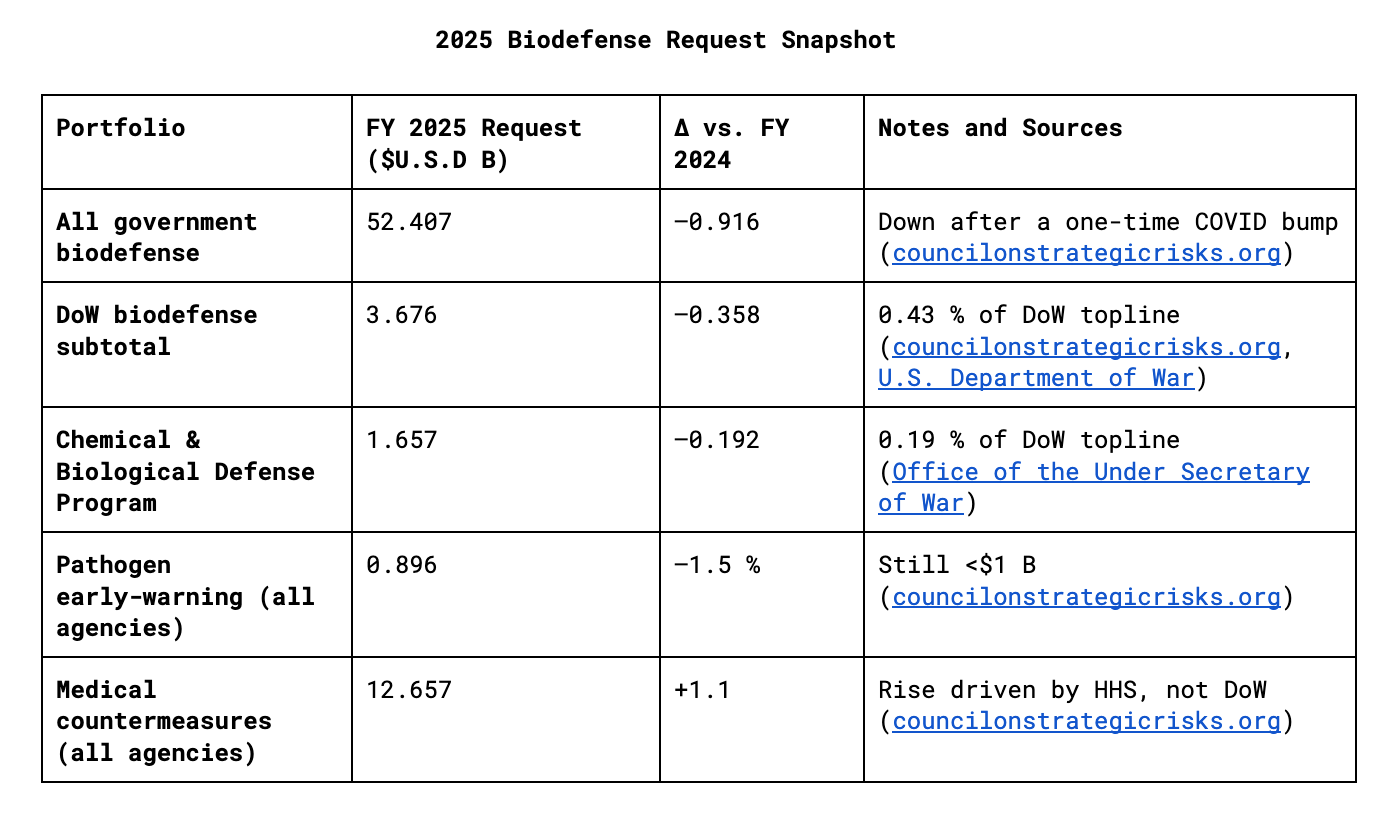
Biodefense outlays are currently an order of magnitude below other strategic domains, especially as a percentage of the Department of War budget. In the FY 2025 request, the entire Department of War biodefense portfolio, including everything from early warning to medical countermeasures, adds up to $3.7 billion, about 0.43 % of the total $849.8 billion defense request. The dedicated Chemical & Biological Defense Program receives just $1.66 billion (~ 0.2 %).
Total biodefense spending, across all government programs, is much larger. The current biodefense allocation FY25 Presidential Budget Request totals $52.407 billion, after a decrease by ~$1B this year. The FY2025 request included cuts to nearly every major joint program, including the Chemical and Biological Defense Program, Cooperative Threat Reduction Program, Defense Health Program, and the Defense Threat Reduction Agency. Although pathogen early‑warning is vital for deterring and detecting biological threats, its FY 2025 allocation still sits below the $1 billion mark, about $896 million, roughly 1.5 % less than last year’s request. (Biodefense Budget Breakdown - The Council on Strategic Risks)
Some of this data is difficult to parse, because there is a massive difference between requested and actual spending. For example, according to the Council on Strategic Risks, the FY23 Presidential Budget Request was for a total of $102B for biodefense programs, but the bill enacted by Congress cut $74 billion from this total, leaving the FY23 biodefense total of $27.727 billion.
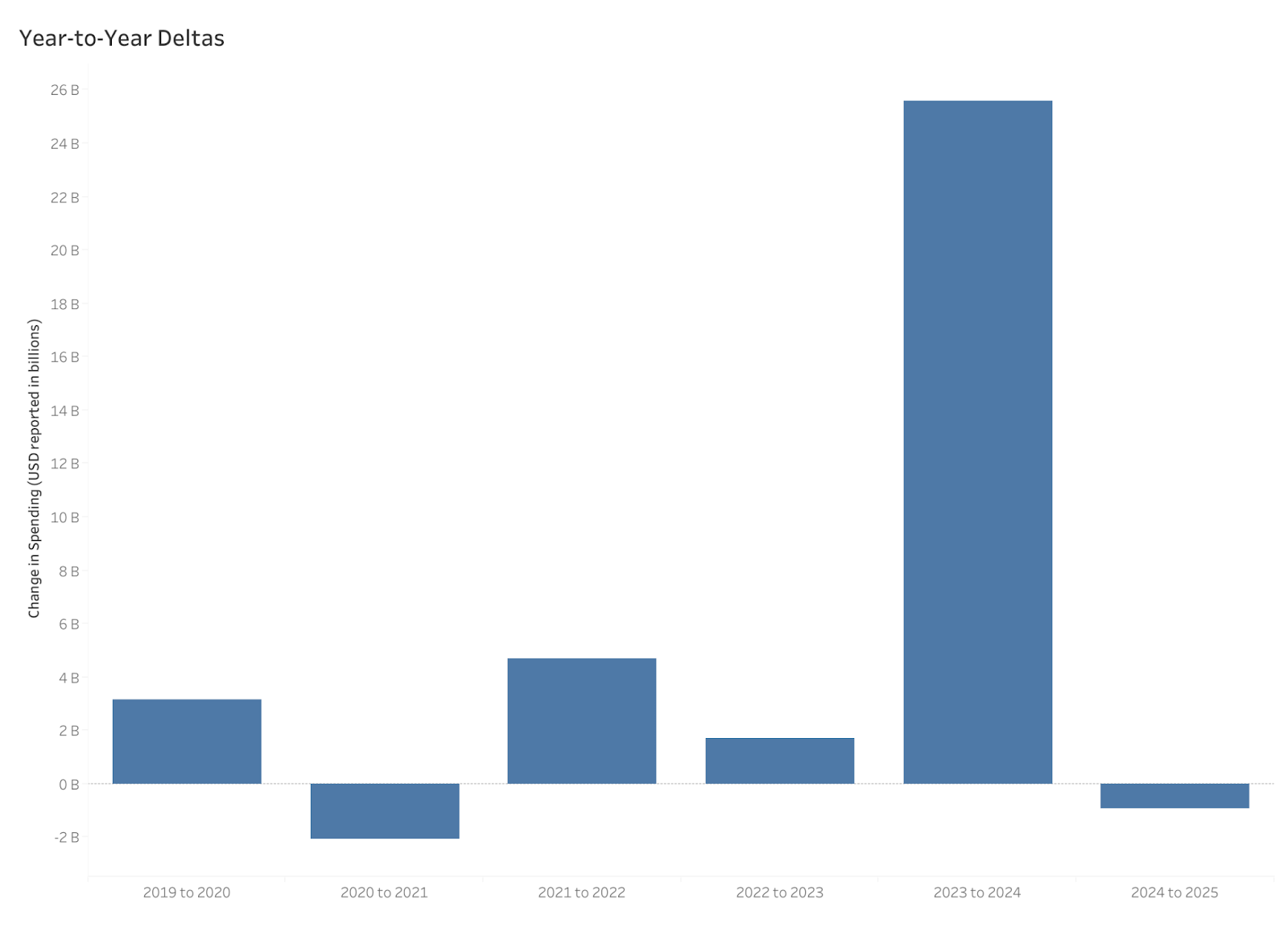
FY 2024 was a massive win for biodefense spending. The FY24 budget was the first to include the one-time $20B allocation for the Public Health & Social Services Emergency Fund ( PHSSEF ) to spend over the next 5 years, plus a new discretionary $400M ASPR (Administration for Strategic Preparedness and Response) line earmarked solely for biodefense MCM (Medical Countermeasures) acceleration. There were also some losses in FY 2024. Under the FY 2024 budget, DARPA declared five biosecurity R&D initiatives (Biology for Security (BIOSEC), Preventing the Emergence of Disease (PED), Outpacing Infectious Disease, Defense Against Mass Terror Threats, and Early Battlefield Interventions) “complete,” eliminating the $53 million they collectively received last year. PREPARE and Gene Editor Enabled Diagnostics & Biosurveillance remain alive but at reduced funding as they enter new phases. The lone biosecurity winner is Deployable Medical Countermeasures for Warfighter Readiness, up to $27 million, roughly $7 million above last year. Below is a chart outlining FY 2024 budget request highlights by agency, broken down further by program where appropriate. (Contact me for sources, as Substack does not allow you to copy & paste tables.)
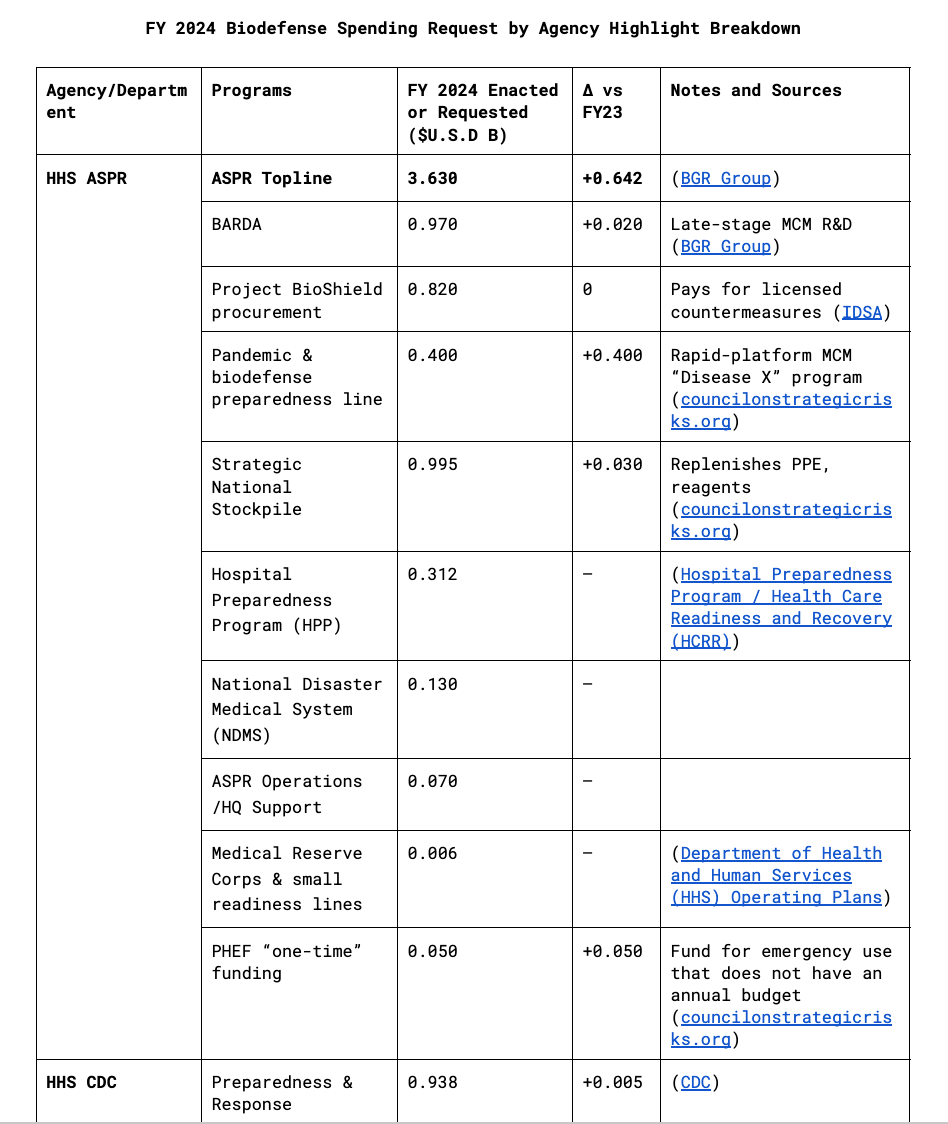
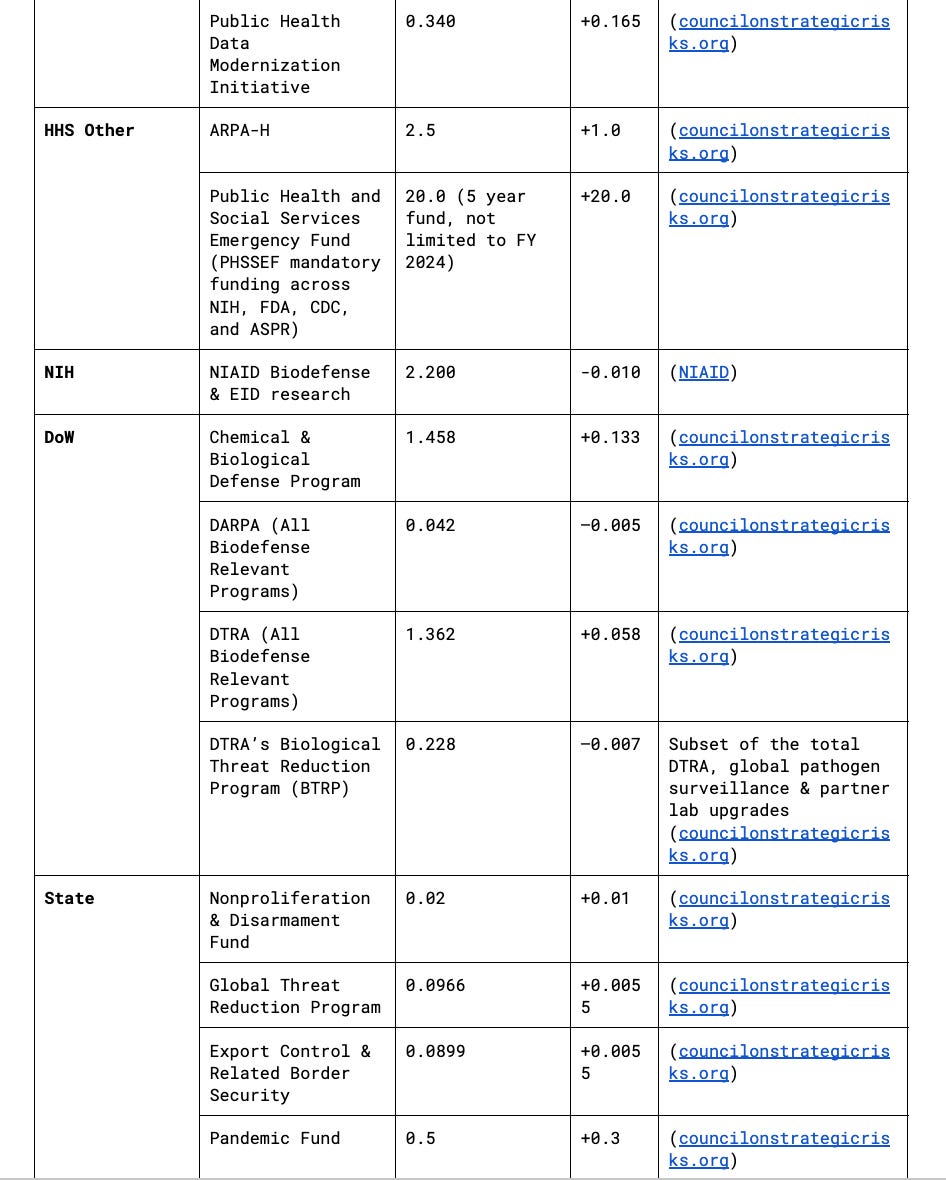
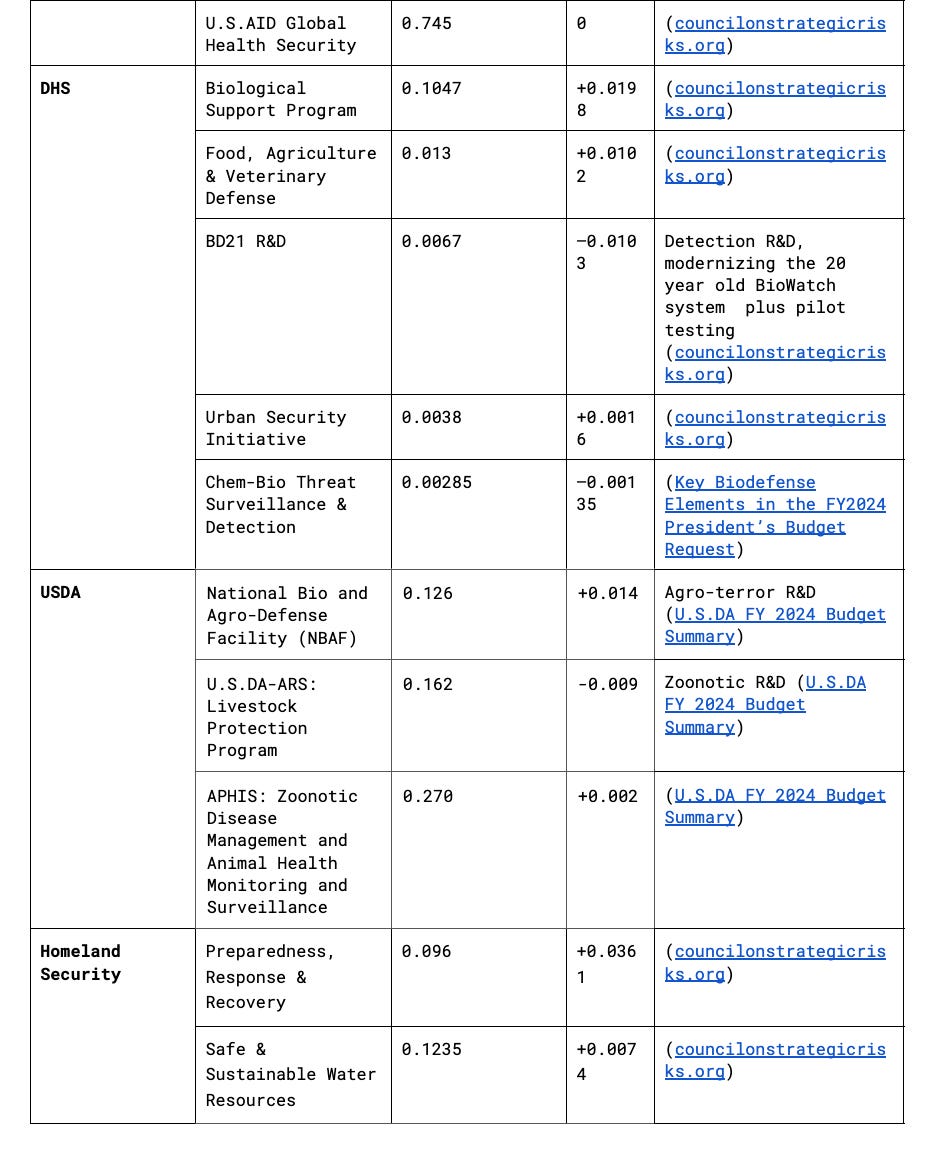
As might become obvious looking at the number of programs funded in the FY 2024 chart, which is only a sample of total programs, limited funding is further diluted by weak governance. You might also notice that there is something to the order of ~$15B missing from the highlights list if you take the Council for Strategic Risk’s total at face value, even with all $20B of the Public Health and Social Services Emergency Fund counted for FY 2024. Much of this capital is going to intramural labs or is estimated, classified defense spending. Some of it is spread across multiple small programs that you might ordinarily assume have little to do with biodefense, or larger programs that are less explicit about their funding allocation. Potential highlights excluded from this table include funding from the NSF, DOE, and, believe it or not, a small slice from the VA.
The Government Accountability Office rightly lists federal biodefense as fragmented and lacking clear leadership, noting the overlap among more than a dozen agencies and no reliable process for tracking readiness gaps. (Biodefense: Actions Needed to Address Long-Standing Challenges | U.S. GAO) The multitude of funding streams and blurred lines of authority leave the public without a clear, auditable view of where biodefense dollars go or what capability they buy. There is no public, published, government‑wide biodefense budget and agencies still define “biodefense” in different ways. Analysts from critical institutions like the Center for Strategic Risk therefore piece the total together from hundreds of line items, estimate how much of the classified budget is bio‑related, and guess how much of multi‑year funds such as the PHSSEF will be spent in the first year. Until agencies use a common cost code for biodefense and Congress embraces clarity, the topline will keep swinging by billions depending on what any given analyst chooses to include. There will always, and should always, be a large portion of classified allocation to maintain our intelligence advantage, but the OMB (Office of Management and Budget) and Congress could and should broadly increase transparency without incurring security risk.
No one wants to fund emergency preparedness when the emergency is out of sight. In 2015, a bipartisan commission convened the Blue Ribbon Study Panel on National Biodefense and published their report urging the U.S. to shore up biodefenses and warning them of the serious risks posed if actions were not taken. The commission reminded us: “As former Secretary of the Navy Richard Danzig told us, ‘We don’t really get to choose what we have to prepare for.’ We have no choice – the Nation must take action to defend against the biological threat.” We did not take sufficient action, and 4 years later, COVID-19 killed ~27 million people, over 1 million of whom were Americans.
The commission also wrote that the “root cause of continuing vulnerability is the lack of strong centralized leadership at the highest level of government.” They recommended power be centralized through the office of the Vice President, because the office can carry the President’s delegated authority to align agencies, budgets, and national strategy across the federal government with the necessary coherence and force. Their new 2024 report recommendation is that the power be centralized through the National Security Advisor. Increasing transparency and communication through centralization is the first step to maintaining U.S. advantage by improving redundancy issues and exposing readiness gaps. We need leadership to drive change.
Without centralized leadership and a long-term memory, U.S. biodefense has failed to sufficiently learn from history and the advice of experts like those on the aforementioned bipartisan commission. Annual funding for biodefense is estimated at $700 million prior to 2001, but spiked to over $4 billion by 2002 and reached $8 billion by 2005 before leveling off around $5 billion annually for the following decade. If you look at the chart below, you can see the one-time $20B allocation added in FY 2024 as a response to COVID-19. Just before COVID-19, the CDC saw cuts to key preparedness lines and repeated proposals to slash its overall funding. Even when Congress reacts decisively after disasters the funding spike is typically short‑lived. Biodefense appropriations surge in the wake of a crisis, then flatten while conventional spending keeps climbing. This must change. Episodic government funding cannot deliver the continuous cutting-edge innovation and high-volume manufacturing readiness the nation needs.
Year-to-Year Deltas
Funding whiplash does not just hurt government programs: it hurts private sector innovators who rely on government funding. Our biodefense advantage relies heavily on these private sector innovators, and it should rely on them even more: cutting-edge technology sharpens biodefense. Government spending in the private sector is often misallocated, and there are strong motivations shifting government-led projects and funding towards more well-understood biothreats, like influenza, and away from biodefense innovations that might protect against novel pathogens. Private-public partnership with innovator discovery biotechs ought to be a major part of the path forward. It is almost certainly rapid, programmable biologic design, advanced PPE, and better environmental protections led by the private sector and backed by Government contracts that will enable adequate defense against bioweapons and novel evolved pathogens. To this end, ARPA-H could take the lead and continue heavily investing in the cutting edge technology it was built for, but with a stronger focus on biodefense. DIU can also support the translation layer, helping transition commercially developed biodefense technologies into DoW procurement pathways.
Most importantly, we ought to allocate at least 1% of the DoW topline for biodefense. Nuclear forces defense spending is projected to account for approximately 7.4% of the total national defense budget as of 2025, and the maximum civilian casualty potential of biothreats is significantly larger. Raising the DoW share from 0.43% percent to 1% would add roughly five billion dollars per year, and bring biodefense into the same category as other high priority strategic domains like nuclear.
This number is justified by risk-weighted expected loss. Pandemic-scale biological events plausibly impose US losses in the $5-20T range. SARS-CoV-2 US losses alone exceeded $15T, with some estimates closer to $20T. Assuming a conservative 1-2% annualized probability of a natural pandemic or COVID-19 magnitude or larger, expected US losses per year are roughly $150-400B. In the lower end of that range, with loss estimates of ~$200B per year, a $5-10B/year mitigation investment is only about 2-5% of expected annual loss. That is conservative by any standard cost-benefit logic.
This additional capital could flow through joint programs and joint solicitations with ARPA-H while the DoW retains strategic control. This would prioritize the newest technology, especially technology that can handle novel, bioengineered pathogens. We could then double pathogen early warning investment to at least two billion dollars and pair every sensor dollar with one investing in countermeasures, including pathogen-agnostic systems like PPE and advanced medical countermeasures. Below this threshold, we will struggle to properly develop national-scale, continuous, pathogen-agnostic monitoring or the programmable countermeasures that are needed. At 1%, we also unlock red-teaming and redundancy. This is the level needed for real innovation in protection against novel threats.
The U.S. is not constrained by capital, but by prioritization, and we can and should treat biodefense as a highest-priority strategic domain of warfare.
Disclaimer: This piece represents my personal views and my personal views only. It does not represent the opinion of any organization I work for or with.