

“I have a friend who’s an artist and has sometimes taken a view which I don’t agree with very well. He’ll hold up a flower and say, “look how beautiful it is,” and I’ll agree. Then he says, “I as an artist can see how beautiful this is but you as a scientist take this all apart and it becomes a dull thing,” and I think that he’s kind of nutty. First of all, the beauty that he sees is available to other people and to me too, I believe. Although I may not be quite as refined aesthetically as he is . . . I can appreciate the beauty of a flower. At the same time, I see much more about the flower than he sees. I could imagine the cells in there, the complicated actions inside, which also have a beauty. I mean it’s not just beauty at this dimension, at one centimeter; there’s also beauty at smaller dimensions, the inner structure, also the processes. The fact that the colors in the flower evolved in order to attract insects to pollinate it is interesting; it means that insects can see the color. It adds a question: does this aesthetic sense also exist in the lower forms? Why is it aesthetic? All kinds of interesting questions which the science knowledge only adds to the excitement, the mystery and the awe of a flower. It only adds. I don’t understand how it subtracts.” -Richard Feynman
Introduction: Dualism and the Quest for Magic
I do not believe in a soul, or, at least, not in the sense that the soul is commonly described. There is a deep desire amongst people to divide the mind and the body into two and take a dualist position. This comes from two places primarily: the first is the desire to escape death and find meaning, and the second is for their conception and experience of the world to align with reality.
First, to escape death is a difficult endeavor without the ability for the mind to be separate from the body. We empirically know what becomes of the body after death. Our neurons stop firing, we decompose, and we can no longer participate in the unfoldings of this world. If death is truly the end, it is harder for us to find meaning. Dualism creates the opportunity to escape this meaningless fate.
Second, dualism aligns with our conception and experience of the world. This is the foundation of Descartes’ Cartesian argument –– that dualism must be true because we find it easy to imagine ourselves as separate from our body. This is deeply flawed. It is easy for us to imagine our mind as separate from our bodies, because, in our experience, it is. We may lose any number of organs or limbs, for the most part, and remain a functioning person. Certainly we remain ourselves. We can imagine ourselves without our body because we cannot see or interact in a profound way with the part of our body that truly is our mind: the complex system of electrical impulses from our brains down into our gut. It is easy to imagine one might exist without something that one cannot see, even if that is not true. There are many counterexamples of things that one might imagine as separate but are really the same. A classic counterexample based on Frege’s semantic puzzles is that Hesperus, the evening star, and Phosphorus, the morning star can be conceived of separately, but in fact are the same planet, Venus. The Cartesian argument is one of many for dualism, but the only one I will address here in light of its relevance to the rest of these notes.
Why is examination of these biases towards dualism relevant to a collection of notes ultimately about free will and determinism? Well, I believe people are biased in quite a similar way to both believe in free will and to refuse determinism as a potential state of reality. People are biased to believe in free will because, to them, it is the only thing that might give their lives, their choices, and their identity meaning. Moreover, as they live and breathe, free will is their conception and experience of the world. They make choices thinking they can choose otherwise, and sometimes they perceive that they change their minds. They are biased against determinism partially because, to them, the two are incompatible, and partially because determinism feels meaningless. I believe that the bias against determinism also comes from a deeper source –– the desire to believe in magic. With determinism, they believe there can be no magic and mystery, no beauty. I believe this is folly.
Beauty and free will are not at odds with a deterministic universe. To say our choices are determined is not to say they are meaningless, or even that they are not free. It is to say they are intertwined with the structure of reality itself. The magic of the universe comes from the miracles of truth and beauty, and there is nothing more beautiful than intertwined life, consciousness, and the sensations that accompany being, qualia.
“Any sufficiently advanced technology is indistinguishable from magic.” -Arthur C. Clarke
Part I: Defining Compatibilism and Outlining These Notes
Compatibilism is the argument that free will and determinism are compatible. I think compatibilism is obviously true, and I present here some of the common arguments for compatibilism intertwined with some of my own. (For those skeptical, it is worth noting that compatibilism is the majority consensus among most modern philosophers. This 2020 survey found that 59% of English-publishing philosophers accept or lean towards compatibilism.) I then argue that some particularly non-strict version of ontological determinism must be true. Finally, I argue that ontological determinism can be beautiful.
Part II: Common Arguments Defending Compatibilism
The separation between compatibilists and incompatibilists can often be framed as a question of how we define free will. What does it mean to be free? What is will? I will address these questions multiple times, from multiple perspectives, in the following sections. I would also like to set up a simple framework for the rest of the discussion of some individual person P, who is choosing or has chosen choice A over choice B.
The Conditional Analysis of Free Will (Hume, Ayer)
The conditional analysis of free will defines free will as meaning we could have done otherwise if our desires had been different. This position allows for freedom within a deterministic system. If no external force is preventing us from acting on our desires, we are free, and we will always choose according to our desires. P has chosen A over B because he wants A, and, though the choice was free, he would not have made a different choice without some novel external cause being introduced. P might ask: but if my desires are also determined, how is my choice free? Compatibilists would generally hold that freedom does not require uncaused desires, it only requires that our actions follow from who we are rather than from some kind of coercion. Determinism does pose a threat to free will when free will is understood as requiring the ability to do otherwise in this reality.
It is worth noting here that I am broadly skeptical of counterfactuals. We can rarely truly say if X had happened instead, Y would be this. Only the weakest version of Y makes a counterfactual remotely compelling. For example, it is a total non-sequitur to say that if I had not spilled blue paint on my canvas, I would have painted a beautiful painting. A version that is stronger might go so far as to say that if I had not spilled blue paint on my canvas in the exact moment and manner in which I did, my canvas would look different. Counterfactuals are generally imaginary and only useful in complete hypotheticals.
Frankfurt Cases: Why Alternative Possibilities Are Unnecessary
Harry Frankfurt takes this a step further, mostly concerning himself with moral responsibility. The core idea is that even if we could not have done otherwise, we can still be morally responsible for our actions. He makes his argument as a series of thought experiments, maintaining that responsibility doesn’t require alternate possibilities at all. In a hypothetical Frankfurt case-framing for our person P, a second person S monitors P’s brain and will intervene if P chooses B, the unethical choice. However, P freely makes the choice A, so intervention is unnecessary. Here, moral responsibility doesn’t depend on the real ability to do otherwise, but rather on the reasoning behind the choice. This thought experiment also shows that free will does not depend on having multiple open possibilities. Instead, what again matters is that we act from ourselves, without external compulsion. That is, unaware of the monitoring person S.
The Self-Expression Argument (Hobbes)
This argument comes the closest to expressing what led me to my conviction in compatibilism. The core argument centers again on how one defines freedom and will, stating that free will is fundamentally about self-expression. That is, we are free when we act in accordance with our own nature. Determinism enables self-expression, because, if choices didn’t follow from the “properties” of the person, you couldn’t meaningfully say they expressed anything.
Part III: Compatibilism, Time, and Identity
The Temporal Argument: Time as an Illusion and Block Reality (Minkowski, Einstein, McTaggart)
We of mankind are profoundly limited in one sense that we are rarely, if ever, asked to consider. That is: we can only move one way through time. We humans experience time as moving forward, but this does not mean that this perception reflects reality. Consider the block time framework. The Eternalist metaphysical view of block time considers all events, past, present, and future, as existing simultaneously. The idea is that everything that will happen has, in a sense, already happened. This assertion that time is an illusion, famously argued via a negative thesis by J.M.E. McTaggart, is only a starting point here. I am going further, constructing a conception of reality as an integrated, Hegelian whole.
The original assertion is often rejected as meaningless or flawed due to wrinkles in time that can be found close to light speeds or in other phenomena. I would argue that the core of the concept remains regardless, because what block time means at its most profound level, is really a kind of block reality. This is sometimes referred to as block universe theory. I use block reality here to most easily allow for the inclusion of multiple universes or any other changes one might want to make. I argue this determined block reality in some sense must exist: even with wrinkles in time, randomness, branching realities, and all the other arguments against determinism, one can simply keep drawing the new block outside of randomness.
What I mean by this is that if you are willing to accept that time is an illusion, you must also be persuaded by the idea that you can keep becoming one-step removed from reality as we experience it. If there is still randomness and wrinkles in block time, it is coherent to just move one step outward, acknowledging those as fixed, too. In this block reality, from our perspective as agents, decisions still unfold as real, intentional choices, and for all intents and purposes they are real, intentional choices. They just happen to be a part of the Absolute, the block reality. This is my argument that some particularly non-strict version of ontological determinism must be true.
Note on Moral Responsibility
At this point, I would like to make a note on moral responsibility. Even if reality is fully determined, we still experience decision-making as a process. Frankfurt cases still apply: we are responsible for actions if they arise from our nature, even if we would never have done otherwise. Moral responsibility is just another fact within the block reality. Our choices are determined, but so is our accountability.
This moral responsibility is not a binary. The forces that shape human behavior exist along a gradient, from strongly influential external circumstances to those that truly arise from the core of a person’s nature. If the universe is deterministic, we ought to hold two truths at once: that all choices are determined, woven into the fabric of reality, and yet some choices should be treated as more of a reflection of an individual’s agency than others. What we owe to each other is not just to hold people accountable, but to do so with an awareness of the forces that have shaped them.
We may recognize determinism without surrendering to indifference on moral responsibility, explicitly because agency and free will are real. A determinist who is not a compatibilist must forgo ethics altogether.
The Identity Argument: Coherence and Freedom
We have spent some time trying to define free will, but, what an astute reader might notice, is that we have really been defining the “free” part. We have spent little to no effort to define will. Will requires a self –– an identity.
A determined identity is explicitly not arbitrary. We change through time, but the continuity of that change is what makes a self a self. If identity included randomness, “you” would be arbitrary, and your choices would lose meaning. Determinism preserves a coherence through time that makes the self meaningful, which is what is truly at the core of Hobbes’ aforementioned argument for self-expression.
When P is choosing between A and B, P’s will, P’s identity, dictates the choice. If P would choose B in some supposed alternate reality, P is not “the same person” who would choose A. Choices are coherent processes emerging from identity. Not only can free will be understood as free self expression as Hobbes argued, I argue choices are defined inextricably from the self. A person P who “could” have made some alternative choice, I argue, has no real identity at all.
One might reply to this to say that in fact it is our choices which define us, not us who define our choices, and try to run around a chicken and egg argument. Under the system of freedom I have outlined, I would argue that this is, in some sense, true. However, it ought to be clear that the egg has, in fact, come before the chicken. That is, while our choices do define us, they are only causal for our future. The system works like dominoes: the self freely picking each choice, which in turn transmutes the self.
Inside the System
I have previously accused alternatives of being imaginary. I would now like to state their use requires a profound misunderstanding of the nature of the Absolute. Not only are we deeply connected to reality, we are reality. There is no real such thing as external factors. One would require an ultimate divine intervention to provide such a thing. We are inside the system, and thus can never perfectly understand it. This does not preclude the existence of a divine entity that might.
Part IV: Determinism and its Aesthetics
Determinism is Not Mechanistic Reductionism
Having established that freedom can coexist with causality, I turn now to the question of what causality itself entails. I am assured that, in recent metaphysics literature, determinism is defined along the lines of this statement from Professor Waller from the University of Sussex: “A complete, true description of the state of the world at a time and the laws of nature entails all other truths about the world, including all truths about what agents do.” I have some issues with the definition. The word “entails” here is tricky. I argue that it is not necessary that any known agent or mathematical system need be able to make this prediction, but that the divine may do so. I also, once again, reject the idea of an individual “time,” which I aver is an overly strong definition by relying on the human experience of time passing. The essential argument against this definition is that it is describing epistemic determinism, not ontological determinism.
My first point in this section supports ontological determinism: the incompleteness of our understanding does not indicate that reality lacks structure. The inability to track causality does not mean causality doesn’t exist, only that it is beyond us to understand it. Modern physics reminds us that our understanding of the universe is, and likely always will be, deeply incomplete.
My second point in this section concerns the aesthetic consequences of a deterministic paradigm. Some determinists make the mistake of assuming that to be determined means to be “controlled by” a mechanical system that leaves no room for meaning. However, what we call determinism may include far more than we currently understand to be “physical.” Moreover, the idea that randomness is the source of meaning and beauty is itself rooted in human limitations. The unknown is one source of beauty, but it need only be unknown to us.
The Garden of Forking Paths: Quantum Uncertainty and Chaos Theory
Many use quantum mechanics and chaos theory to argue that reality is fundamentally indeterminate.
Quantum mechanics introduces probability distributions, which I argue are part of a larger deterministic framework. Probability distributions in quantum mechanics are our best guesses at what the Truth will look like when we interact with it. All of our systems are unable to understand or resolve the complexity of a quantum state before we interact. This does not imply that the system will not inevitably resolve, or that there is no way for something nonhuman to predict the eventual outcome. It only implies that we cannot, in our limited, human capacity, predict that resolution. The same is true for chaos theory. Chaos theory is about the difficulty of prediction, not the absence of causality. Once again, the universe may be complex beyond comprehension, but that does not mean it is not structured.
Even if quantum mechanics or chaos theory does introduce true randomness and we ignore the block reality concept, making determinism is false, I argue that this would not do anything to support the notion of free will as most would think. A random choice is no more free than a determined one; it is merely arbitrary. What is arbitrary, we ought to know in our hearts, loses meaning rather than gains it.
The last consideration here for now is the possibility for multiple worlds. The many worlds theory has grown in popular science and in academia. If this is indeed the true nature of our reality, that complicates the aforementioned arguments a bit. Perhaps person P is free to decide to either live in world A or B, depending on their choice. I maintain that if both worlds exist, both “versions” of P exist identically as the original person P, and it is determined that P will make both choices. I argue that this entire garden of forking paths exists within the block reality, and P is an inextricable part of the maze, not simply an agent navigating within it. We cannot be an “agent” even if quantum mechanics or chaos theory allows for real uncertainty, because randomness is fundamentally anathema to will. For P to be considered an “agent” navigating with the maze, I believe we would have to concede the existence of the soul and the reality of time as something that binds even G-d.
Gödel’s Incompleteness Theorem and the Limits of Determinism
Gödel’s incompleteness theorem shows that not all truths can be derived from a formal system. Through mathematical analogy, this suggests that there are aspects of reality that transcend fixed logical structure, and many use it as an argument in establishing indeterminism. But does this really imply indeterminism? I would argue that not only does it not establish indeterminism, it effectively argues against typical indeterminist philosophy.
Here, it is worth once again revisiting block reality. Consider this universe, this system as a whole existing, with all its bits and pieces. I challenge the reader to tell me that a statement like “This statement is false.” does not exist in such a system, simply because it is not provable within the system. (It does exist –– it’s right there! Do ignore that I am assuming the conclusion here.)
The structure of reality may be deeper than we can logically describe, and it is Gödel’s theorem which implies that provability is a weaker notion than truth. Again through mathematical analogy, this supports the idea that our inability to predict the future or understand the present with certainty does not necessarily imply a lack of ground truth. While Gödel’s theorem may imply epistemic determinism is impossible, it also implies ontological determinism is sound.
Indeterminism is Argument ad Ignorantium
Randomness as an element of reality is often defended by Occam’s razor. Some believe that since we cannot mathematically model or comprehend something, it must be random. This is a false dichotomy and an argumentum ad ignorantiam. The principle of parsimony is often abused in this manner. If one insists on using Occam’s razor to choose indeterminism, I will insist that it actually points to determinism. Determinism does not require exceptions.
Moreover, I would once again argue that randomness itself, if it exists, has a place in block reality. If our experience of time is essentially an illusion, then even randomness does not imply indeterminism, but rather a limitation of perspective. That is, randomness could be considered to be as determined as anything with a true direct cause might be, perhaps even by virtue of the divine. (But theological determinism is beyond the scope of these notes.)
The Fractal Beauty of Determinism
As mentioned previously, some of the motivation for the rallying cry against determinism is the pervasive fear that a determined universe is banal. This lacks imagination.
I had the privilege of studying fractal geometry under Michael Frame, who co-developed the field with Benoit Mandelbrot. Fractal geometry provides an excellent example for the aesthetic potential of determinism. Consider the Mandelbrot set. It is defined by a simple, deterministic equation: fc(z)=z2+c. In the absence of randomness, and even in the absence of will, this simple equation generates infinite complexity. As you dive into the cosmic boundary of the set, you witness spirals, landscapes, and symmetries –– strikingly beautiful and endlessly novel. A person could explore the set for a billion years and always find something new, yet it was all ontologically determined the moment the equation was defined.
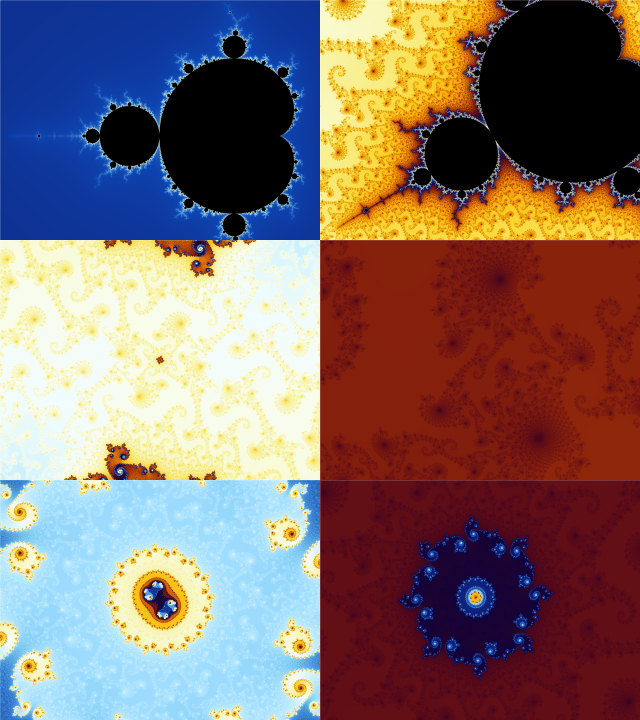
This is analogous to the model for the universe I propose. Randomness has no structure, and, therefore, no meaning. A deterministic universe, however, is a fractal of infinite depth. The magic is here, in the complexity of a flower, the qualia of being, and the passing of time. We are immersed in the boundary conditions of a cosmic fractal, exploring an infinitely beautiful landscape.
Conclusion: Compatibilism and Magic
To conclude: free will does not require an escape from determinism, and, if any semblance of the soul exists, it is embedded within reality itself. The idea that this should lessen our reverence at existence is foolish. Yes, we forget the profound joys of qualia. We are magic, and so magic is mundane. Instead of seeing free will and determinism as opposing forces, we should see them as interwoven aspects of a reality beyond our comprehension, and be glad for it. If we are determined, we are determined by something incomprehensibly vast and beautiful.
“Beauty is truth, truth beauty, — that is all ye know on earth, and all ye need to know.” -John Keats
You touched really well on the illusion of time, so I would like to add into the mix the illusion of aesthetics, I always like to remind myself of the Greek sense of aisthesis as in “perception” — everything is beautiful, but also everything is perception, and therefore illusory in nature. Chaos is the lack of definition, so definition (order, cosmos) itself is the creator of new worlds (new zoomy spirals in the fractal). "Let there be light" the gods said, so there was an universe. What is a universe (or a block-reality)? Your head is an universe, my head in an universe, we live in an universe! —it doesn't matter, all universes are created equally, but light itself is an ordering mechanism, at a “soul” level a certain aspect of light binds us to destiny, to the sun, to the stars, to the entirely of the rest of the universe (not for nothing all ancient cultures had some sort of astrological calendar dictating fate). We're not separated, "so above, so below". What happens up there in the stars tells the same story, not repeated but it rhymes, with the history we're living down here.
Wanna hear another illusion? Will. It is out there, but most people use it only at most 0.000001% of their time while they're alive. What is actually running in the background is just "programs" (habituations, routines, repetitions, patterns), but again even in the most obtuse computer Grace shows up from time to time. In that context, imagination is an act of free will and literally a way of moving across worlds, where time can flow backwards, day is night, and up is down. Change the ordering mechanism and you change the entire universe. That is one of the "entry parameters" in the fractal equation, a cosmological matrix that receives parameters and spits out universes.
Perception is just the experience of that, the experiences of an axis mundi at any interesting point of convergence inside the fractal-word, which gives the emergence of the sense of "self" and "i am experiencing" —yet it's into itself another illusion, the illusion of the "self", we can dismantle it and try to identify not with your body but with the entire Earth, another planet like Venus, or you can just be the entire milky way; your writing invites deep mysticism very quickly Olivia!. But I also want to affirm and resonate with the grounding reality of what you say, in special on how ethics play in cosmology, moral responsibility, because in the end we don't live in a fantasy world of matrix of light, we live in coarse reality, where actions have consequences, and we have a personal responsibility, for sure! I will only bake into that perhaps we also have a destiny to fulfill. Not only as personal level, but also at our families, societies, nations and the entire planet for that matter. There's another part of our "soul" that binds us to the terrestrial level, an “earthy” soul-strata, but that's another whole can of worms! (see the Nahua understanding of ihiyotl, or similar concepts like Egyptian Ka but they all at some point they all have to do with Death, moral judgement, sins, etc. It's just another part of being alive in this reality I guess.
Anyways, I really think and practice with these concepts my literal life and my day to day, so I'm happy to read this from you, it was soooo cooool to read!