At the time of writing, I’ve chosen a logo many of you will recognize from Conway’s Game of Life. Conway’s Game of Life is a Turing-complete cellular automaton that demonstrates emergent complexity. If you would like to try it for yourself before reading further, here is a link. (This will not be very interesting to you if you have already looked into it.)
The game is defined by a grid of cells existing in binary states as “alive” or “dead.” The behavior of the entire system is pre-defined by local state transition logic, applied to every cell based on its eight neighbors:
An alive cell remains alive IFF it has exactly two or three living neighbors.
A dead cell becomes alive IFF if it has exactly three living neighbors.
This is interesting because, with these two simple rules, depending on the starting state, complex structures, including those with infinite loops or infinite motion, emerge. The system can generate structures capable of movement, memory, and linear propagation. Conway’s Game of Life is Turing-complete. That is, a simple grid defined by rules that fit on a Post-it is capable of universal computation.
This emergent complexity, to me, is an excellent demonstration of some of what I wrote in my previous post on the aesthetics of compatibilism. Namely, it shows that complex and beautiful things can emerge from simple, deterministic settings.
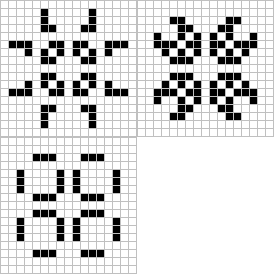
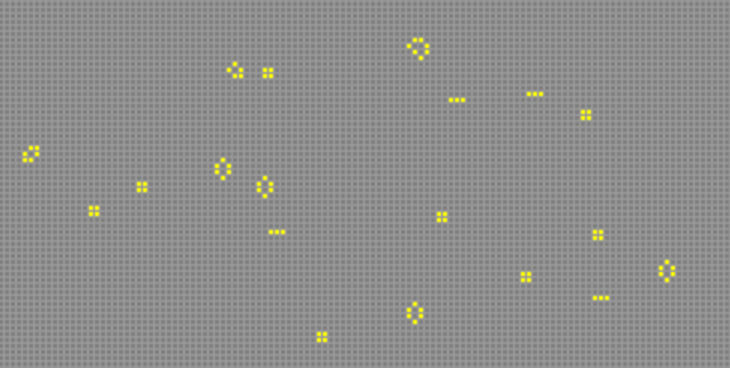
Conway’s Game of Life has captured the imagination of many mathematicians, computer scientists, biologists, and laymen over time. Even Google plays the game if you search “Conway’s Game of Life.” Its popularity means that many of the emergent structures are categorized. Below are some interesting examples of those categories with visuals, including the Pulsar, the logo I chose. The Pulsar is a stable and persistent period-3 oscillator i.e. it cycles through three states before returning to its original state. It gets its name from how we see neutron stars, but I think it looks somewhat like a heartbeat.
Oscillators
Patters that oscillate between a fixed number of states.
Beacon (period-2)

Pulsar (period-3)
Spaceships
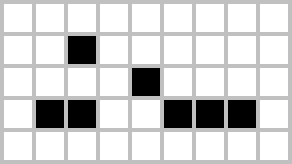
Patterns that move across the grid by copying themselves, slightly translated.
Glider

Heavy-weight Spaceship
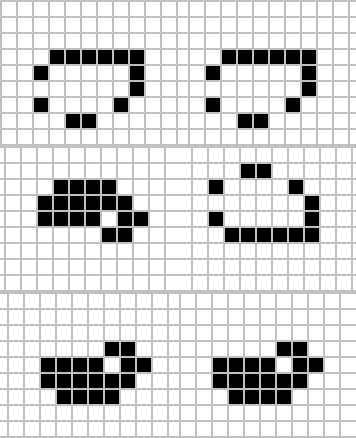
Agar Ship: Greyship
Agar ships are spaceships built around a patch of agar, and greyships are agar ships with that patch at exactly 1/2 density.
Methuselahs
Patterns that evolve over many generations that eventually stabilize. Highly recommend trying these out for yourself –– they’re beautiful.
R-pentomino
1103 generations, generates 116 cells, including 6 escaping gliders.
Starting state:
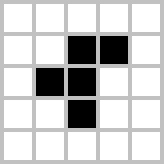
Ending state:
Acorn
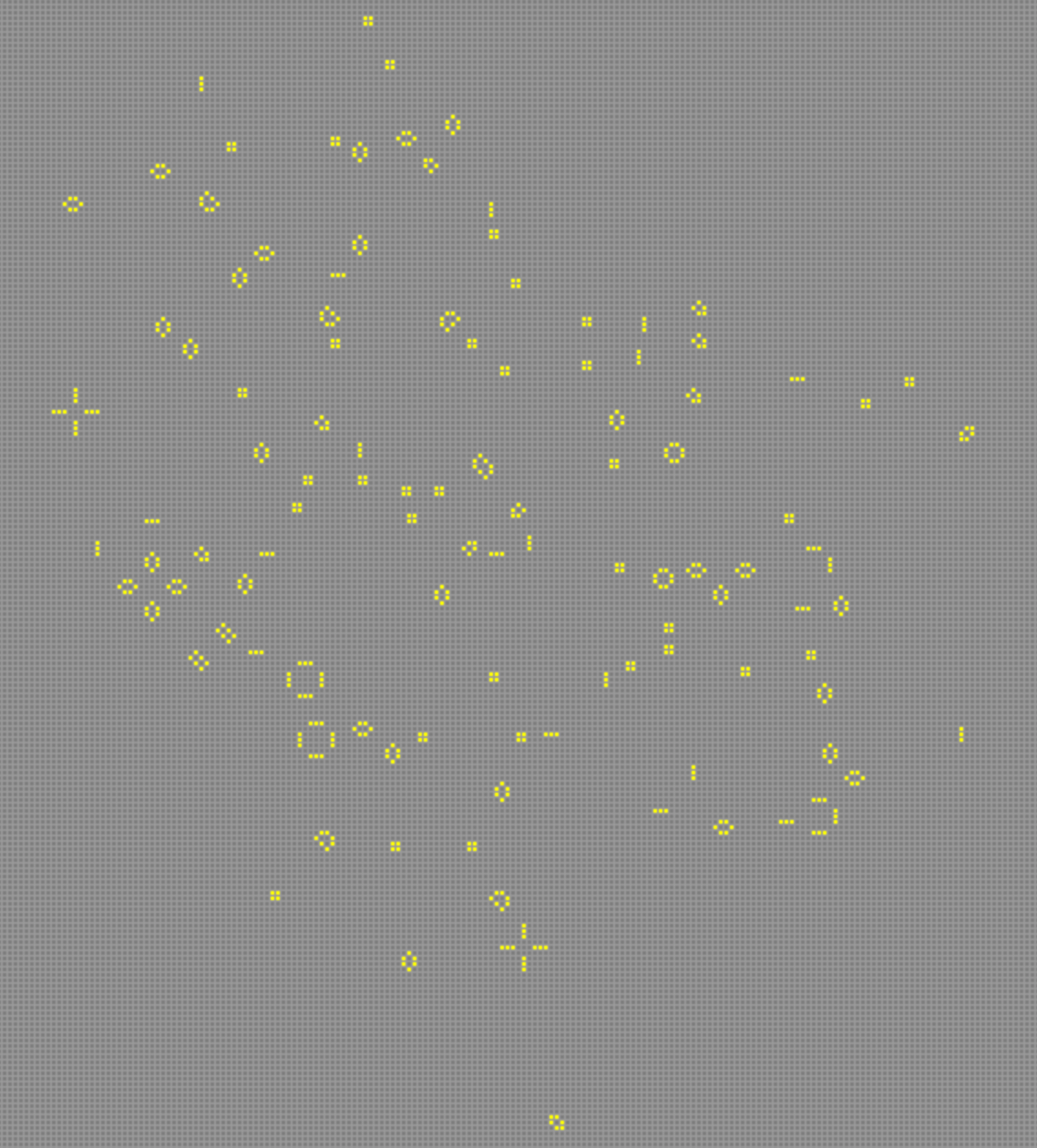
5,206 generations, generates 633 cells, including 13 escaping gliders.
Starting state:
Ending state:
Video:
Puffers
Patterns that move like a spaceship, except leave debris behind.
Block-laying Switch Engines
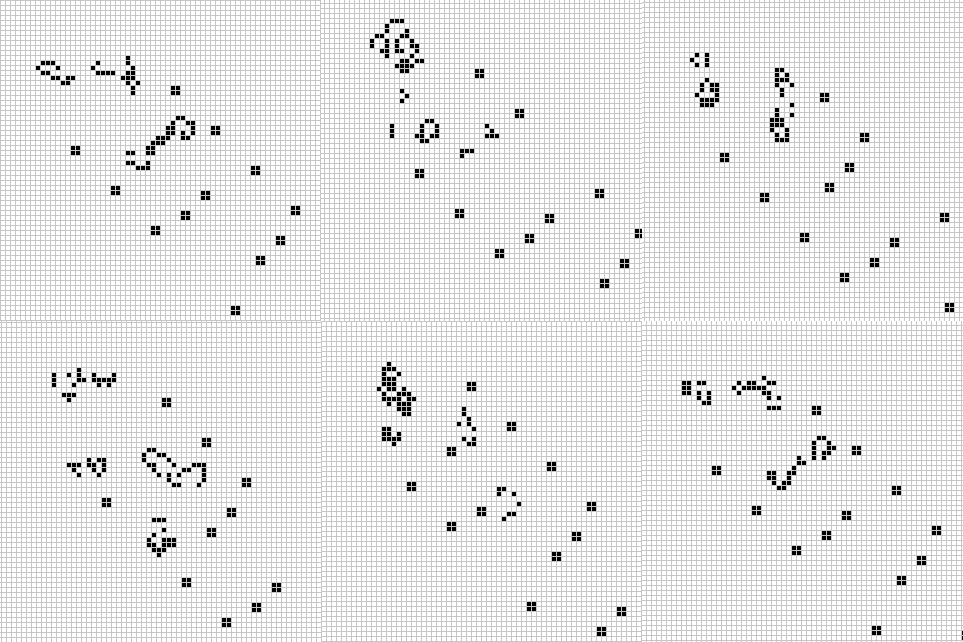
There are multiple block-laying switch engines, all infinitely lay 2x2 still life blocks while translating themselves like a spaceship across the grid.
Guns
Patterns that produce spaceships forever.
Gosper’s Glider Gun
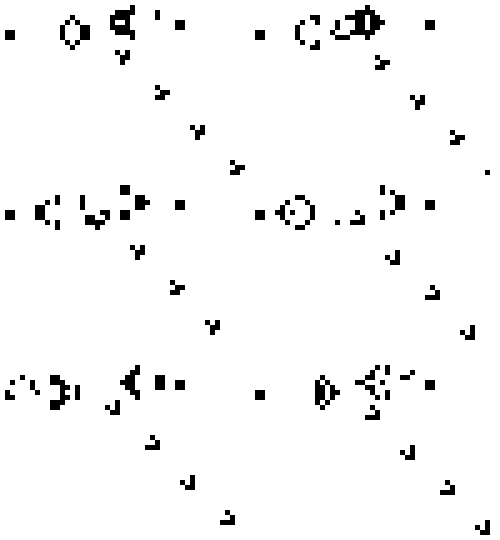
The reminder here is to maybe distrust your intuition about complexity. We have a cognitive bias that links complexity with complexity, but we should probably be linking complexity to iteration. I think this is meaningful philosophy in the context of frontier sciences, like training large models or trying to understand how we get a cell from a genome.
If this is interesting to you, some other things to look into are Garden of Eden patterns and the search for self-reproduction. However, I do warn looking into it leads people to make things like this: