

There is a class of single-celled eukaryotes called spirotrichs which perform some of the most amazing biology in existence. This post will primarily focus on one species in the class, Oxytricha trifallax, so that we can write with more details, however, much of what we are about to discuss applies to spirotrichs broadly or ciliate protozoa as a whole. This organism constructs its own working genome, one that contains 18,000 chromosome types (humans have 46).
Most of the work on this organism is coming from the Landweber Lab at Columbia, formerly at Princeton. Professor Landweber has a great talk on this if you’re interested in more of the experiments run to figure some of this out. It was this talk that first got me interested in the topic. I will also link some papers at the end of this post.
Conjugation and Reproduction
Starting with the basics, these microorganisms do not reproduce sexually. To maintain diversity, they exchange genetic material through a process called conjugation, while the reproduction step is entirely asexual. They have two nuclei, a micronucleus and a macronucleus. The micronucleus is the germline, meaning that it is the one used to do genetic information exchange. The macronucleus is the working nucleus of the cell, meaning that it is responsible for the protein production and other normal cell activities.
Below is a simplified walkthrough of how this works, with a few steps skipped for brevity. On the top, you see asexual reproduction through cell division. Top to bottom, you see the process of conjugation through the formation of a new macronucleus.
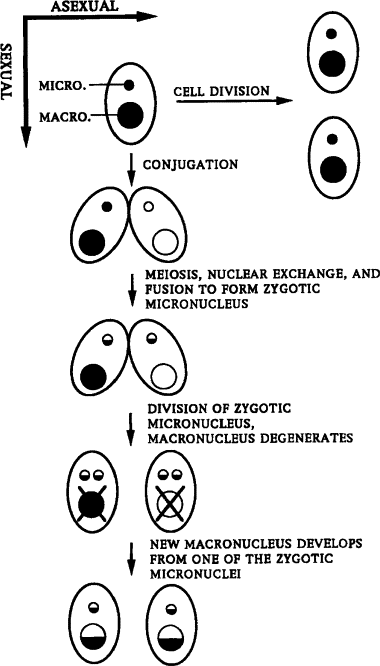
Here is a walkthrough of each of the steps of the conjugation process:
Conjugation
Two cells connect and form a cytoplasmic bridge.
Meiosis
The micronucleus in each cell undergoes meiosis, producing four haploid micronuclei. Three of these degrade. One is kept and copied through mitosis, such that there are 2 haploid micronuclei in each cell.
Nuclear exchange
One haploid micronucleus is exchanged by each cell, so that they each end up with 2 haploid miconuclei, one from each cell.
Fusion to form zygotic nucleus
The 2 haploid micronuclei in each cell join to become zygotic (diploid) micronuclei.
Division of zygotic micronucleus
This is where it becomes interesting –– the new zygotic micronucleus in each cell undergoes mitosis.
Macronucleus degenerates
There is still an old macronucleus in each cell. These degrade.
New macronucleus develops from one of the zygotic nuclei
In each cell, a new macronucleus is made through multiple complex mechanisms from the material of one of the zygotic nuclei that just underwent mitosis. This is the step this post will focus on.
The whole process takes ~60 hours.
The Puzzle
The micronucleus contains numerous sequences that are not functional so far as researchers can tell, so these bits need to be removed to create the macronucleus. Just 5%-10% of the original sequence from the germline remains. You may at this point be wondering why the micronucleus is small and the macronucleus is large, if a micronucleus is transformed into a macronucleus by removing all these non-functional bits. The answer is that the 18,000 remaining chromosome types are each amplified to ~2,000 copies, so the total number of chromosomes in the macronucleus is actually roughly 36 million. (Humans, again, have 46.)
This may now seem like no puzzle at all. However, there is a catch: the genes in the micronucleus are not in order. Many are interrupted by non-functional sequences right in the middle of a gene. Some of them are not even in the right direction. These approximately 225,000 small DNA segments must therefore be excised and arranged in the correct order to build the macronucleus. Some chromosomes must be assembled from over 200 individual segments, each coming from different parts of the germline.
How do they do it?
Pointers
There are short repeat sequences called pointers (borrowing the term from computer science) that act sort of the way tabs and holes do on a traditional jigsaw puzzle. Most are between 5 and 20 bp long, but some of them are as small as two base pairs, which is not a lot of information to work with when you are assembling a quarter million piece puzzle.
Researchers realized they are not sufficient. There must be another mechanism helping to orchestrate the overall architecture of the genome and tell the cell which sequences to keep or delete. If you are wondering why I am writing about this, you may have already guessed that that something is non-coding RNA.
lncRNA and piRNA
On step 6, the old macronucleus begins to degrade. Before it does, Landweber’s lab discovered that ~all of its 18,000 chromosome types get transcribed (sense and antisense) into thousands of long non-coding RNAs (lncRNAs). These transcripts are therefore a complete RNA-level copy of the previous generation’s genomic structure, and can theoretically act as a template/blueprint, giving the cell higher-order instructions for how to build out its new zygotic micronucleus into a macronucleus.
Landweber's group tested whether these lncRNAs are acting as templates by injecting synthetic RNA templates encoding an altered segment order, swapping segments labeled 4 and 5. The next generation assembled their chromosomes with the segments in this new order, as did the F2 and F3 progeny, demonstrating lasting RNA-mediated epigenetic inheritance. (How do you see this? The lab ran PCR from segment 4 to the end of the gene. If they are not swapped, the sequence includes both 4 and 5. If 4 and 5 are swapped, the distance from 4 to the end is short. You can then see the difference in size by running them on a gel.)
RNAs transcribed from the macronucleus chromosomes also get processed (possibly from lncRNA) into millions of 27-nucleotide piRNAs (Piwi-interacting RNAs). These piRNAs map to regions of the genome that must be retained in the new macronucleus. If a piRNA exists for a stretch of DNA, that DNA will be protected during assembly. Landweber’s lab tested this and were able to get the Oxytricha to keep (usually degraded) target sequences using external piRNA.
In the talk I linked earlier, Landweber notes that the number of piRNAs in the Oxytricha genome and the number of dots in Seurat’s A Sunday on La Grande Jatte painting are approximately equal. I like to think that this says something deeper about information, but that may be wishful thinking.
DNA Methylation
More recently, the lab discovered that methylation also plays a critical role in this process. 6-methyladenine (6mA) is a DNA modification that had long been known to exist in bacteria, including in Oxytricha. In the late teens, new techniques revealed more 6mA in multicellular organisms like Drosophila, C. elegans, and mice, and possibly humans (this is controversial).
Working with Tom Muir’s chemistry group at Princeton, Landweber’s lab began to look for the enzyme responsible for methylation in Oxytricha. Leslie Beh, who led this work, discovered that it was actually a complex of four proteins, and that the catalytic components were not DNA methyltransferases at all. They were RNA methyltransferases, co-opted to act on DNA by pairing with two DNA-binding proteins.
The lab showed that 6mA sits in the linker regions between nucleosomes (where the nucleosomes aren’t), such that adding or removing them directly affects nucleosome positioning. This is necessary to survival during conjugation. When they knocked out the methyltransferase, the cells seemed approximately normal at first. They then died during the conjugation process.
New research indicates that 6mA also acts as a protective mark, guided by the piRNAs.
Why do we care about Oxytricha?
Besides being a really, really cool, almost alien organism, Oxytricha functions as an incredible model organism for all things chromosome. Oxytricha’s tiny chromosomes are small enough to synthesize in vitro, and they have all the features of human chromosomes except for centromeres, including telomeres, nucleosomes, histones, and various modifications. They also come with their own editing system. Labs do not need to use CRISPR for experiments like the one that discovered piRNA protects certain segments. They’re also ~easy to care for, and the conjugation process is inducible through starvation. This makes them the perfect model for RNA-mediated epigenetic inheritance.
Oxytricha is also of interest to the RNA world hypothesis. The RNA world hypothesis is that the original mechanisms for genes and inheritance were all RNA, with DNA developed later as a hardware-like storage mechanism. That is, RNA is the original molecule of life. Oxytricha seems like an organism that has not transitioned as fully to DNA as the primary mechanism, given the RNA-derived methyltransferase system and the extensive use of ncRNAs to pass the genome architecture information. Landweber and Aaron Goldman discussed this connection explicitly in a 2012 Trends in Genetics paper.
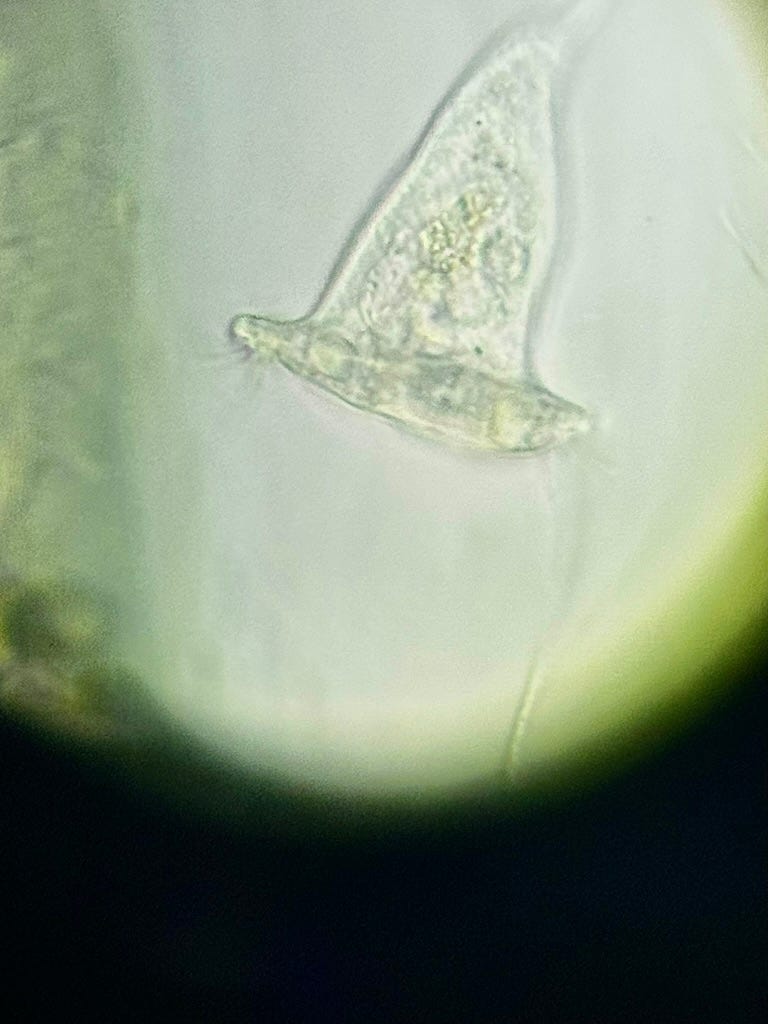
As a way of closing, ciliates as a class are everywhere. Here is an image from my own microscope of a ciliate called Vorticella in some pond water from the Madison Square Park Reflecting Pool:
If you are interested in reading more about Oxytricha, I have linked some of the relevant literature below, organized by subject:
Papers
Genome architecture
Swart EC et al. (2013) “The Oxytricha trifallax Macronuclear Genome: A Complex Eukaryotic Genome with 16,000 Tiny Chromosomes.” PLoS Biology
Chen X et al. (2014) “The Architecture of a Scrambled Genome Reveals Massive Levels of Genomic Rearrangement during Development.” Cell
Newest info showing 18,617 distinct chromosomes: Lindblad KA et al. (2019) "Capture of complete ciliate chromosomes in single sequencing reads reveals widespread chromosome isoforms." BMC Genomics
lncRNA-mediated epigenetic inheritance
Nowacki M et al. (2008) “RNA-mediated epigenetic programming of a genome-rearrangement pathway.” Nature
Lindblad KA et al. (2017) “Thousands of RNA-cached copies of whole chromosomes are present in the ciliate Oxytricha during development.” RNA
piRNA-mediated epigenetic inheritance
Fang W et al. (2012) “Piwi-Interacting RNAs Protect DNA Against Loss During Oxytricha Genome Rearrangement.” Cell
Zahler AM et al. (2012) “Mating of the Stichotrichous Ciliate Oxytricha trifallax Induces Production of a Class of 27 nt Small RNAs Derived from the Parental Macronucleus.” PLoS ONE
Programmed chromosome deletion
6mA
Beh LY et al. (2019) “Identification of a DNA N6-Adenine Methyltransferase Complex and Its Impact on Chromatin Organization.” Cell
Angelova MT et al. (2026) “A PIWI protein-dependent DNA N6-adenine methylation pathway in Oxytricha protects genomic sequences from deletion.” bioRxiv preprint
RNA World
Goldman AD, Landweber LF (2012) “Oxytricha as a modern analog of ancient genome evolution.” Trends in Genetics
Goldman AD, Landweber LF (2016) “What Is a Genome?” PLoS Genetics
Germline-limited genes
Villano D et al. (2021) “Transcribed germline-limited coding sequences in Oxytricha trifallax.” Genetics
Review
Yerlici VT, Landweber LF (2014) “Programmed Genome Rearrangements in the Ciliate Oxytricha.” Microbiology Spectrum
One doesn't need to fully understand something to see that it's super-cool. This post is proof. (For me, anyway.)
Injected synthetic RNA and it rewired how the next three generations built their genome is wild!